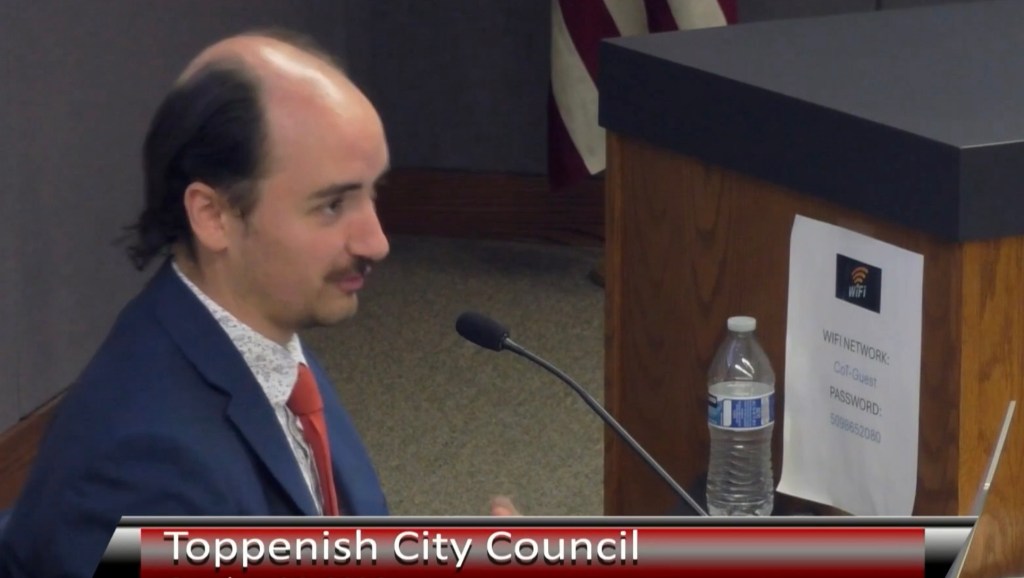
Cable channel programming, live streaming council meetings expected to continue unless terminated by cities
By: Mike Fong and Laura Solis, Lower Valley Matters
October 31, 2026
Will Granger cut its contract with Midvalley Television (MVTV) to livestream and record city council meetings for next year? If so, it won’t be because of a cost increase to Granger in 2027 according to Toppenish City Manager Adam Vaughn.
Lower Valley Matters reported on October 21 that Granger was considering cutting ties with MVTV due to rising costs associated with federal regulations for closed captioning and other accessibility requirements. While Vaughn believes these and other costs can be managed in the near-term, Granger, Toppenish and Wapato will soon need to confront the reality that the current model for providing public, educational, and government access programming is not sustainable at the current funding levels.
Funding for MVTV. Toppenish, Granger, and Wapato fund MVTV with fees and taxes collected from Spectrum/Charter Communications (“Spectrum”) through a cable franchise agreement. Cable companies seek franchise agreements with cities to use the public right-of-way to serve cable TV customers. In exchange, cable companies pay the city fees and taxes collected from those customers.
In 2019, Granger, Toppenish, Zillah, and Wapato had agreed to commit the money they received from Spectrum to fund MVTV (“interlocal agreement”). However, Zillah pulled out of the interlocal agreement shortly after the franchise agreement went into effect to use its franchise revenues differently. The City of Toppenish operates MVTV and manages its budget, though the cities jointly govern the station.
Toppenish is Absorbing Rising Costs (For Now). The current cable franchise agreement with Spectrum runs from 2019 until 2029. But since 2020, the costs of operating MVTV has outpaced the fees and taxes collected from the franchise agreement. In 2019, the revenues generated from Spectrum were around $138,000, and the cost to run MVTV was about $120,000. But by 2024, the revenues collected from Spectrum had dropped to under $100,000 (likely resulting from a precipitous decline in cable TV subscribers). This trend has Toppenish projecting revenues of only $50,000 to $80,000 for 2026 and 2027. Meanwhile, the cost to run the station has grown to as much as $160,000 annually.
For now, Toppenish is covering the shortfall with other funds (including costs associated with the new federal requirements) and plans to continue to manage the budget until the cities and Spectrum renegotiate the franchise agreement in 2029. Until then, Toppenish has no apparent plans to charge the other cities more for the services. Vaughn is eyeing a continual regional approach in 2029, but he acknowledges that each city could go its own way. He told Lower Valley Matters, “We’ve basically just been moving forward with the idea that MVTV in its current state will last through the agreement, then when the franchise is renegotiated, we would work through a model that is sustainable for all of the cities.”
Redeployment of Fees. While the original plan called for the cable franchise revenues to fund public access television, the cities could redeploy their revenues toward something else in their budget. That’s what Zillah did in 2019 and what Granger is now reportedly considering. Wapato Mayor Margaret Estrada responded to our inquiry about whether they planned to continue contracting with MVTV by saying “we will keep them.”
Toppenish charges each of the cities an additional $1,200 a year for MVTV to provide online live stream and video archiving of council meetings and other events. This fee has been in place for two years, but Vaughn says Toppenish has not proposed to increase it at this time. He confirmed that “the costs for MVTV for Wapato and Granger is essentially just that the revenue from the franchise goes to MVTV instead of their general funds. We also charge a $1,200 fee to each city for video web streaming costs.”
Toppenish projects Granger’s cable franchise fee and tax revenues for 2027 to fall to $12,500 (it was $24,000 in 2019). This means that if Granger were to withdraw from the interlocal agreement, it could save $13,700 ($12,500 plus $1,200 streaming costs), but this does not factor in the cost of providing alternatives for public TV or online (live and recorded) streaming access to council meetings and other community events – should it choose to continue doing so.
Both Toppenish and Granger’s City Councils will be discussing the 2027 budget over the next two months. You can watch their meetings here on MVTV.


Leave a Reply