By: Mike Fong and Laura Solis, Lower Valley Matters
November 9, 2026
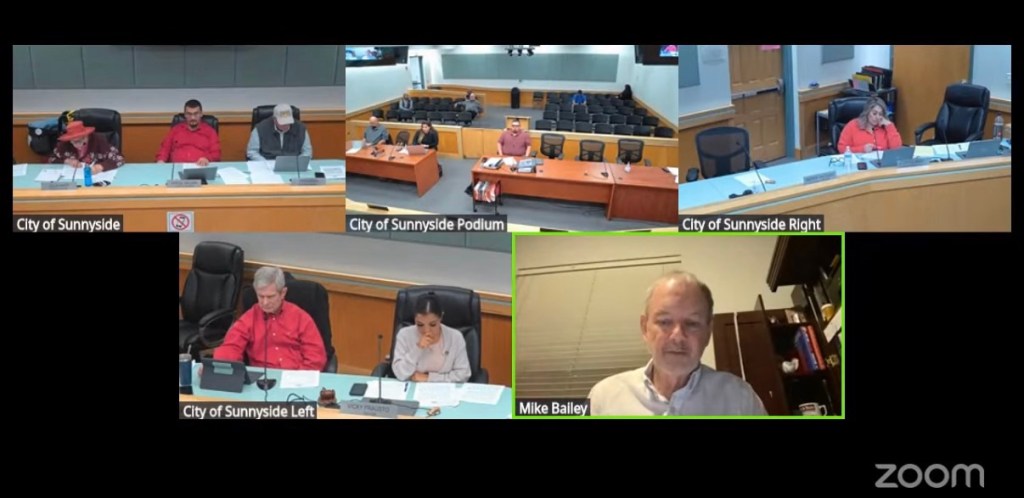
At the October 28 Sunnyside City Council meeting, Mike Bailey, the consultant hired to analyze the current state of the city’s finances, walked the council through a presentation showing that there is a $2-3 million general fund deficit on the horizon for Sunnyside’s 2027 budget.
Bailey, a long-time finance director for several cities in Washington State, was hired to bridge the work on developing the 2027 budget until new City Manager Mouhamed Zaher’s arrival. His findings revealed significant near and longer-term budget challenges that the new city manager will be facing.
General Fund Deficit. The city’s general fund represents some of its most flexible funding to provide basic services. General fund dollars pay for police, fire, parks, roads and city administration among other day-to-day operations and comes from property, sales, and utilities tax revenues.
According to Bailey, the city is overspending in several departments. He believes that the city will reach the end of 2026 over budget by at least $200,000, if not more. While efforts are being made to control costs for the rest of the year, Bailey believes that the deficit could grow to $1 million by the end of 2026. “[It] wouldn’t surprise me if it did,” he said.
This deficit would be the starting point for the 2027 budget. Compounding the problem is that for 2027, the city’s general fund revenue is expected to come in at $15 million, but the estimated cost to continue providing services at current levels is $16.9 million. That means the city is facing a $1.9 million gap that would either need to be filled with new revenues or budget cuts. That would be on top of dealing with however much the city ends up in the red for 2026.
How did this happen? Bailey identified three specific issues that contributed to the 2026 overspend: First, Sunnyside’s 2026 projected budget started with a surplus of $300,000 from 2025, but this was incorrect: the city had actually overspent its revenues in 2025 by $228,000. This resulted in a $528,000 error. Second, the 2026 budget anticipated revenues of $1 million in interest earnings, but the city has never earned more than $230,000 in interest in any year. Third, several city departments budgets were “artificially low,” meaning they were built on unrealistic expenditure assumptions. These departments have already overspent their budget for 2026 with two months left in the year.
Where to go from here? Bailey described immediate cost containment efforts to curb any overspending as much as possible for the rest of the year.
He has also corrected the budget assumptions for 2027 spending (resulting in his conclusion that $1.9 million more is needed to maintain current levels of service). But still to be accounted for in the 2027 budget is the actual overspend carried over from 2026 (Bailey estimates this to be somewhere between $200,000 to $1 million). Ordinarily, the budget process for the following year starts months earlier, but Sunnyside has been contending with several transitions in leadership positions and only now, through Bailey’s efforts, is discovering the magnitude of the problem.
Given that the 2026 issues were identified so late and that actual expenses for the rest of the year are still up in the air, Bailey thinks it is too late to create a budget for 2027 that resolves these issues and the new city manager should be involved. As Bailey noted, “we don’t have time to deal with that kind of challenge.” As a result, Bailey and Interim City Manager Pat Haley are recommending an admittedly unorthodox approach for now: a “stop gap” budget that would punt the issue to early next year. On paper, the budget would be balanced as required by state law (showing $15 million coming in and $15 million going out), but it would be acknowledged to be unsustainable beyond October of 2027. In early 2027, the budget would have to be amended to make necessary spending reductions and/or revenue increases (through taxes, fees or other resources). With this approach, Bailey believes that Sunnyside could get to a “legally balanced budget,” but as he notes, “it’s not fiscally sustainable.” If the stop-gap budget is not amended to address the financial realities, Sunnyside would be risking a massive financial cliff in October that would require ending services, layoffs, and program stoppages.
Councilmember Jorge Galvan said he appreciated the work that Bailey and the finance team were doing, but that it “seems like another band-aid, another budget another band-aid…kicking the can to January…I don’t like the stop-gap thing. We have 62 days.”
Mayor Vicky Frausto noted that “I get Councilmember Galvan’s frustration…it’s hard to feel Ike you are in this again…I’m just trying to figure out how we can dialogue around this…so we make sure we have these check-ins that are needed.”
Interim City Manager Haley emphasized that “we have now in place the team to solve the problem. We have not had that in 26’. We were deficient in all sorts of leadership in every department.”
Ultimately the Council concurred with Bailey’s approach, but emphasized a collective commitment to move forward aggressively to deal with the budget challenges as quickly as possible before the end of the first quarter of 2027.
Beyond dealing with the challenges for 2027, perhaps even more unusual is that the city has no general fund reserves. As Bailey notes, cities typically have 12-20% of their general fund in reserve for emergencies, which is like maintaining a balance in your checking account to deal with unforeseen circumstances. For a city with a general fund budget the size of Sunnyside’s, the reserves should be between $1.8 million to $3 million.
Incoming City Manager Zaher will need to quickly get up to speed to address these significant financial challenges or risk the city digging an even deeper hole than it is already in.
You can read Mike Bailey’s memo here (beginning on page 86 of the packet).


Leave a Reply