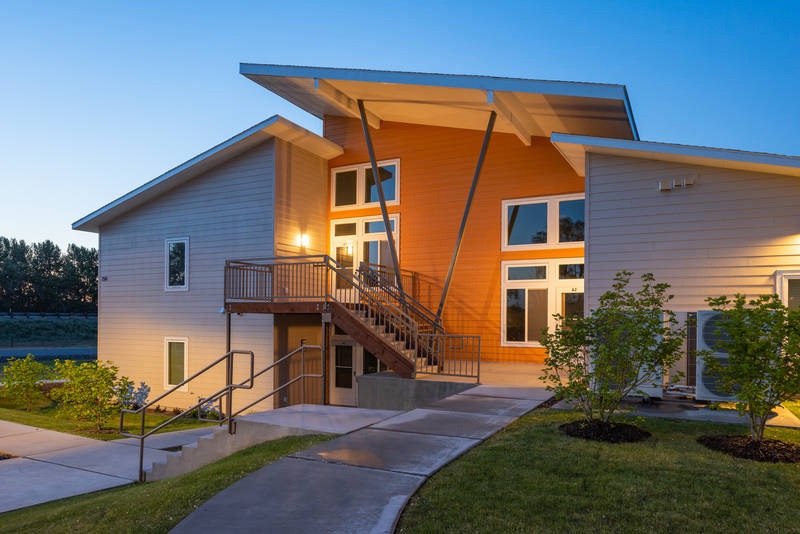
This August marks the 8-year anniversary of the Yakima Housing Authority’s (YHA) completion of the Cosecha II project in Granger.
Our look-back on this project is not intended to cast any aspersions on the program or the workers and families that have called Cosecha II home. In fact, by all accounts, residents have been good neighbors in the community and, the program is meeting some individual shelter and farming needs. YHA has been a reliable and responsible operator of the housing facility.
In this post, we examine how this project came about, the source of funding, and explore whether the originally stated goals have been achieved.
Background
The Cosecha II project is located at the intersection of Hwy 223 (Outlook Road) and Cherry Hill Road in Granger. Cosecha II is a 96-bed facility that provides H-2A guest worker housing between the months of April and November. From December to March, the beds convert to short-term housing for homeless families in the region. This building is distinct from Cosecha I, which provides housing for domestic migrant farm workers.
In 2018, YHA, local farmers and then State Senator Jim Honeyford and State Representative Bruce Chandler advocated for the Cosecha II project to receive $3 million of Washington State Housing Trust Fund (HTF) resources to help build the project. The HTF is the state’s “workhorse” program that provides funding to build and preserve affordable housing for residents of Washington State. To achieve this goal, HTF awards hundreds of millions of dollars each year to public housing authorities, non-profit organizations, local governments, tribes and other entities to develop and manage housing units and maintain affordable rent levels for WA residents that qualify based on income and particular needs.
What makes Cosecha II unique?
Farmworkers and homeless families are certainly in need of affordable housing. However, there is one big wrinkle to Cosecha II: by Federal law, the responsibility to provide housing for H-2A guest workers falls on their employers, the farmers.
The use of our state’s taxpayer dollars to fund housing for temporary guest workers was and remains highly unusual. These funds are typically reserved to help preserve and create new affordable housing for Washington residents – especially critical given the housing crisis across our state.
So what were the reasons given by advocates at the time for allocating these dollars to building guest worker housing when the HTF is routinely oversubscribed with requests for funding by 2-4x more than the amount of money available each year?
3 reasons Cosecha II was funded
Reason 1: Funding Cosecha II for H-2A workers with state money would help prevent rising housing costs in the Valley.
A key argument advanced by advocates of Cosecha II was that H-2A demand had reached a point where large corporate farmers were buying up old motels and existing apartments and homes to accommodate the housing needs for these guest workers, resulting in reduced available housing stock. This, they argued, would drive up housing costs (rent and homeownership) for everyone else living in the Valley. For an example, you need look no further than the Fairbridge Inn and Suites in Sunnyside, which was converted to H-2A housing in 2026. But even setting aside H-2A housing needs, there is an overall shortage of housing across the entire state. Adding to that demand, Washington farmers have utilized as many as 38,000 H-2A guest workers just a few years ago and will likely end up close to those numbers in 2026. Since 2018, H-2A visas in WA State have grown by more than 10,000 workers a year.
Cosecha II’s 96 beds have done virtually nothing to meet the rising housing pressure caused by the use of H-2A workers in our region. Nor has Cosecha II remotely helped hold the line on rising housing costs. Median home prices in the Valley have gone up by 60-90% since 2018 and a rental unit costing between $700-$750 back then is now going for $1,000-$1,125, a 45% increase.
Verdict: False. Ultimately using Cosecha II for H-2A housing has had virtually no impact on the explosive growth in housing costs and raises questions about whether this approach in investing $3M in this project was the best way to preserve affordable housing in the community for residents of Granger or the region.
Reason 2: The project would stimulate Granger’s local economy and in turn support growth in local tax revenues.
The potentially positive impacts on the local economy was apparently a rationale Granger City Hall relied on in approving the project. It is hard to quantify how the additional 96 temporary residents may contribute to the local economy. Often, H-2A workers are provided transportation to larger business hubs in Sunnyside (think Walmart) to shop and meet their daily needs. On the margins, there might be some increase in spending in town for local businesses. But, when it comes to taxes collected by the city to invest more into the community – this proves to be very minimal. First, Yakima Housing Authority projects are exempt from property taxes. So they don’t have to pay taxes to the city like private homeowners and apartments owners have to pay. Also, sales tax in Granger is 8.2%. Of that amount on each purchase made, the city only gets to keep 0.85%. If you spend $100 in town, and pay $8.20 in sales tax, only $0.85 cents goes to the city to pay for roads, or cops or other basic services. Even if those 96 guest workers spend $300 each a month in town for 9 months, the city is bringing in less than $2,000 in additional sales tax revenue a year. That doesn’t feel like a major boon to the city budget and local economy.
Verdict: Marginal at best, but most likely false.
Reason 3. Granger’s homeless families would have shelter and temporary housing.
There is no question that homelessness is a challenge for the entire Yakima Valley. In 2025, the state’s official one-night-count identified more than 600 people living on our streets across the region. Over a full year, more than 3,000 people cycle through homeless services across Yakima County. Having a local homeless shelter helps meet a critical need. But this is a regional need – and not just a Granger issue. In fact, the two agencies that refer families to Cosecha Court II are based in Toppenish and Sunnyside. Without a doubt, having these beds is helping regional homeless people in need, but it is unlikely that they are helping ease Granger’s local housing troubles.
Verdict: Arguably true, but likely meeting a much greater region-wide need and not one that is disproportionately a Granger challenge.
At the end of the day, revisiting this taxpayer investment is not to question whether this is helping people in need. It clearly is based on the demand for the facility. But 8-years later, it is worth revisiting what elected community and agency leaders were saying about the project and holding people accountable that are empowered to make multi-million dollar decisions on our behalf. We should ask questions about how these types of investments ultimately serve the residents of our own community. Granger was selected for this project given that YHA already owned the property on Cherry Hill Road. One can also assume there may have been less community push back from Granger than in Zillah, Sunnyside or other nearby towns that are just as, or more, conveniently located for farmers and H-2A guest workers. At the same time, state HTF funding is extremely competitive to secure and the opportunity cost of using limited public funding for this purpose rather than affordable housing for people who actually reside in this community is reason enough to ask if this was really the best decision with the residents of this community in mind.


Leave a comment