By: Mike Fong and Laura Solis, Lower Valley Matters
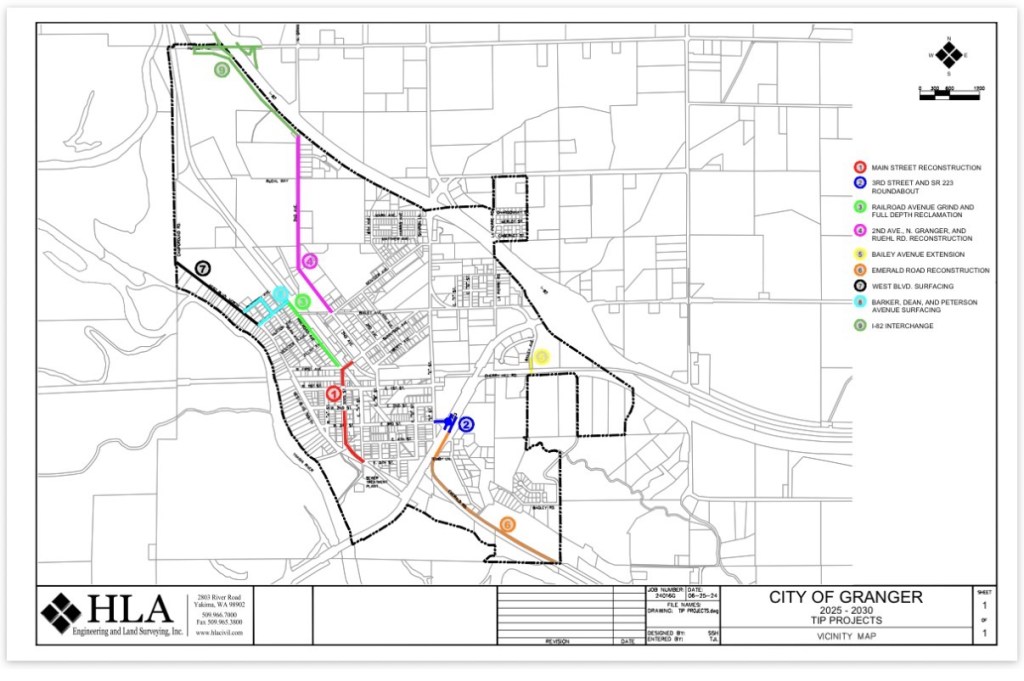
At the September 8th Granger City Council meeting this past Tuesday, Granger residents Rebecca and Jesse Chavez shared their concerns with the deteriorating condition of Second Avenue. The Chavezes, who live on Anahi Lane behind Granger High School, shared their experience with frequent car repairs and swerving around potholes, as well as their concern that first responders could be delayed in responding to an emergency.
This short stretch of Second Avenue falls between Bailey Street and Ruehl Way, an area with dozens of homes and residents who rely on the roadway for ingress and egress to town and school. The area is zoned for heavy industrial use, including Cargill’s dairy feed mill and retail feed manufacturing facilities, Post 5 Cattle Company’s feedlot, and Quality Liquid Feeds. This pocket generates a high volume of daily traffic from heavy 80,000 pound semi-truck rigs. Cargill’s recent 2025 expansion added a substantial amount of local truck traffic to the roadway.
Long-Standing Safety Issues. The potholes, dust, pedestrian and school safety concerns, and heavy traffic volumes of Second Avenue are not new to city residents or the council, but the solution remains elusive.
At the August 25th Granger City Council meeting last month, Councilmember Juan Isiordia discussed concerns about air quality problems and dust from the semi-trucks on this stretch of Second Avenue. Families, he said, had resorted to watering the roadway with hoses to keep the dust down so that kids could play in their yards. He added that the watering is likely making the potholes worse over time.
Where to go from here? Cargill highlighted that one of the primary benefits of its new packaged-feed production site is an overall reduction in miles that long-haul (out of state trucks) traveled on the interstate highway system. But freight activity on Granger’s streets has surged.
Second Avenue needs full reconstruction and was probably never built to withstand the level of stress from high truck volumes. But, as Mayor Hilda González remarked at the August 25 City Council meeting, such a project could cost as much as $3 million or more. For context, the City’s entire annual budget hovers around $6 million, and funds appropriated for ongoing street maintenance is only $86,000 for 2026.
Below are approaches that have been discussed by the Council and some new ones that could be considered.
Federal and State Grants. The City has applied for grants and placed the project into their Transportation Improvement Plan (TIP), queuing it up as a transportation priority. The City has also worked with the School District to pursue funds together. Although Granger has been successful in obtaining grants in the past, even if it was successful in winning a grant to fix Second Avenue, it would take time before any improvements could be made. Right now, it is priority four on a list of nine projects.
Public/Private Partnership. At the August 25, 2025 Council meeting, Councilmember Isiordia raised the possibility of bringing Cargill “back to the table” to discuss solutions for the roadway and mentioned that the previous mayor had conversations with Cargill about paying for asphalt repaving. Mayor González remarked that a “public road” was not “solely the responsibility” of Cargill. Her preference was also to avoid “band-aid” solutions and to pursue a more comprehensive fix.
Transportation Impact Fees. Many cities in Washington State, including Yakima and Ellensburg, have Transportation Impact Fees (TIF) that they impose on new building projects to help pay for roads and sidewalks to absorb increases in traffic brought on by that project. Granger has not adopted this tool. If the City adopted a TIF now, it could not apply retroactively. A TIF in the future would increase the cost of new developments, but would generate revenues toward the infrastructure needs brought on by new projects. In other jurisdictions, these fees are seen as “growth paying for growth.”
Transportation Benefit District. The Mayor mentioned that the Council had recently discussed Transportation Benefit Districts (TBDs) and that she had highlighted this tool in her 2026 budget book cover letter. Creating such a district would enable the City to potentially impose up to $50 license tab fees or a 0.1% sales tax rate increase on Granger residents to help fund transportation projects without voter approval. Fees and taxes higher than these amounts could be put on the ballot for voters to decide. Yakima, Sunnyside, Toppenish, Grandview and Wapato currently have TBDs in place.
Re-Routing Truck Traffic. In the meantime, a short-term solution could be re-routing truck traffic. The City and the Granger School District worked out the current route agreement with Cargill before their new facility was completed, re-routing the trucks off of Bailey Avenue to Sunnyside Avenue to bypass Roosevelt Elementary and Granger Middle School.
Cities typically have the power to dictate truck routes through an ordinance (without an agreement) through their roadways, including time-of-use roadway restrictions. Such a decision would have operational impacts on the industry in the area, but this option could be an alternative to mitigate impacts on residential neighbors.
No easy solutions appear to exist to the condition of Second Avenue, but a broader discussion about Granger’s transportation funding needs—and the Chavezes testimony last week—are perfectly timed for the Council’s upcoming deliberations over the public’s priorities for the 2027 budget.
You can watch the Granger City Council’s discussion about Second Avenue here: https://reflect-midvalley.cablecast.tv/internetchannel/show/1069?site=4
You can watch the Chavez’s public testimony here: https://reflect-midvalley.cablecast.tv/internetchannel/show/1072?site=4
If you enjoyed this article, follow-us on facebook at: https://www.facebook.com/profile.php?id=61593626991667
You can read more Lower Valley Matters articles at: lowervalleymatters.com

